Thursday, 18 November 2010

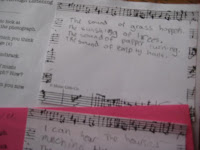
Seeing Through Listening Part II 13th November


The flow of viewing public was at first less responsive to my invitation to experiment
with the idea of an additional way of engaging with an image through imagining sounds or music. However as the gallery became busier over the afternoon, this changed dramatically. There were some fabulous dialogues and wider discussions to be had.
An elderly gentleman considered that Carrie Mae Weems images would be improved
by removing her out of them.
Another lady, very stimulated by her audio journey concluded that Susan Lipper's work
caused her to see the entire exhibition as 'Lynchy', ie through a 'David Lynch' filter.
As before, choices of music when more abstract, rather than direct responses to the
location of the American South, illustrated that this stimulus conjured forth a wealth of personal memories and reflections.
Numerous people expressed the effects of viewing the kind of poverty of an earlier era,
as a sobering experience, but that the exhibition itself had such a quality of focus that
they felt enriched by it rather than depressed.
Two young american photographers had made a special journey from Edinburgh to see the exhibition and were impressed by what they found. They were surprised at how little information was available in Brighton regarding this exhibition.
They were very sorry not to have found a ready response with a soundtrack, but through further discussion revealing their understanding of both the Appalachian community
as well as Susan Lipper's work were able to explain away the mysterious nature that the hanging of a deer in Lipper's iconic image, is a common practice to drain its blood.
Younger children enjoyed considering in great detail the kind of sounds which they might hear.
Several individuals found that films were also brought to mind as connections with
hidden memories and could be an easier thread to follow than a soundtrack.
Almost all who responded were intrigued by the addition of an extra dimension
through sound, finding that it encouraged them to enter more intensely into a moment depicted within an image, which had the ability to subtly reveal so much
about the invisible individuals who left traces of their presence.
For instance, one man was intrigued when he noticed the small detail in a William Christenberry image, of what appears to be a wooden hut is in fact made from redbrick.
Three friends concluded the day with their refreshingly different ideas about music to accompany Susan Lipper from Motorhead, Depeche Mode to Blondie.
Another fascinating day.

Thursday, 11 November 2010

Warhol is Here exhibition announced


Warhol Is Here
ARTIST ROOMS On Tour with the Art Fund
24 September 2011 – 8 January 2012

Warhol is Here at the De La Warr Pavilion will present and explore the work of Andy Warhol in the context of his beliefs, lifestyle and above all, his legacy for the 21st century.

Emphasis will be placed on Warhol’s importance to audiences, and particularly to young people, who have been exposed more to the myth of Warhol rather than the content and context of his work.

The exhibition will include early drawings, stitched photographs, self-portraits, very large screenprint canvases and a number of posters. They will be taken from a selection of works from ARTIST ROOMS, (a new collection of modern and contemporary art held by Tate and National Galleries of Scotland for the nation,) as well as those sourced from other private and UK collections.

The Pavilion will also show a programme of films made by Warhol and will publish a small handbook of essays by artists, curators, writers and musicians commenting upon the memory, influence and impact of Warhol.

Following the critical and popular success of Beuys Is Here which attracted over 45,000 visitors in summer 2009, the De La Warr Pavilion is delighted to take part in the second ARTIST ROOMS tour where 21 museums and galleries across the UK (including 17 venues outside of London and Edinburgh) in 2011 will be showing ARTIST ROOMS, exhibitions and displays from the collection assembled by the art collector and curator, Anthony d’Offay.

For further information about Warhol Is Here, please contact Sally Ann Lycett on 01424 229137 or sally.ann.lycett@dlwp.com

To find out more information about ARTIST ROOMS On Tour please visit www.artfund.org/artistrooms.

To see the full ARTIST ROOMS collection please visit www.tate.org.uk/artistrooms and www.nationalgalleries.org/artistrooms

De La Warr Pavilion
Marina
Bexhill on Sea
TN40 1DP
Information: 01424 229111http://www.dlwp.com/

Monday, 8 November 2010

Interaction Day 30th October.


Better late than never. Sorry for the delay in posting chaps. The interaction day on the 30th October perhaps could have run a little more smoothly. I was planning to do a tour for this session with some interaction projects for the wee ones, but we were slightly hijacked by a Walk & Talk with curators Celia Davies from Photoworks and the De La Warr’s Jane Won. The gallery was extremely busy and their tour was brilliant. For my next session on the 11th December I promise I will factor a discussion and tour for those that felt they missed out. Any how, we had another fun afternoon with lots to think about. The brief I set was slightly different from my previous one, looking at objects and scenes that evoked a personal memory and then reflecting on that through drawing and text. This was instinctive for some and harder for others. It was interesting to observe how diverse and disparate the viewing process is. Connecting images to your own experience is not familiar to everyone and is by no means a guarantee of a good gallery experience either! Some felt it irrelevant and a distraction and others were inspired by the new insight. One lady wrote 3 pages of her own memory of her first visit to Sri Lanka which was connected to a photograph by Walker Evans. I particularly liked the story from a boy who found a snake skin in the corner of a shower in Australia. This memory was evoked by William Eggleston's image of a trailer park in 1974. Well done to all who participated. Fascinating.

Sunday, 7 November 2010

Lift The Lid


Another busy Lift The Lid family session with more photography in it this time. Titled “Remix 2” and building on the previous session, participants were asked to take a clipboard into the exhibition or go around the building and sketch or write down objects and colours that appealed to them. They could then make these elements into an original picture using pencils and collage.

They could also go off with one of the Pavilion's digital cameras (but not into the gallery as photography is not allowed in Myth, Manners and Memory). Children aged from about 6 to 10 proved very adept at producing well composed pictures then critically editing them down to the four they were allowed to print out (so the queue for the laptop didn't get too long and the thirsty printer didn't run dry).

Our youngest artist was a very fast crawler and chose performance art as her medium, using masking tape and scrunched up balls of paper and chewing pencils to great effect.

Here are some of the works produced in the three hour session.


Thanks to all who took part and to our excellent volunteers Corin Smith, Nik Medhurst and Ben Wade.

Thanks also to the anonymous angry person who began his/her comment on the last Lift The Lid of 3rd October “I think that this is not art, if it was art it would need skill, this is not skill, a five year old could do better!!!” (Please add your own comment using the link below).


Saturday, 6 November 2010

Gallery interaction: Your questions please!

When I first saw Myth, Manners and Memory my head was filled with questions about how and why the pictures were made and how they fitted together to make this exhibition. So I asked visitors of all ages to write down questions that came into their heads whilst looking at the exhibition in order to compare my own reactions to theirs.

Here are transcriptions of many of the questions written on the clipboards that I placed around the gallery:

William Eggleston

What is the significance of the tricycle? Is its scale and condition a factor or is this just a moment in time?

Why questions not comments? Is there a great deal of meaning I'm not seeing because I'm not American? e.g would the design style of the 'Gulf' sign make me feel nostalgic if it were part of my cultural lexicon?

Red ceiling 1969-71: Is this the ceiling of a brothel? Does the colour red have a hidden meaning or symbolism?

William Eggleston portraits

Has it been photoshopped (the blue sky is so intense)?

Is that a scar on his face? (girl aged 8)

Who are these people?

Is his name Bubba?


Alec Soth

Overheard from 10? year old boy: What's so amazing about photographs? No-one answered him – a missed opportunity?

Is Alec Soth looking for idiosyncracy (or does it just find him)?


Walker Evans

Why are there posters on the building? (girl aged 8)

Why were the blacks treated so badly?

What are those boys holding?

Who were the FSA? What was their purpose? Why were they documenting the lives of the rural poor?


Federal Writers Project

Where can I find out more about the Federal Writers Project?


Carrie Mae Weems

Why is the lady standing on the railway track?


William Christenberry

Why is that house on stilts? (girl aged 8)

“Why were all the coloured people left to live in rack and ruin? (girl aged 12)


Susan Lipper

Who are these people?

Why are there not very nice subjects?

Why take photos?


To my surprise this exhibition does not seem to lend itself to easily verbalised questions but most definitely does encourage discussion. Over the afternoon I had many excellent conversations with visitors from as far afield as Devon and Sheffield. Many of them were very knowledgeable about photography (some were touring Brighton Photo Biennial and Photo Fringe venues). Many of the people who wanted to talk about the exhibition did not want to write down specific questions.

The answers to many of the questions are of course online, but I do recommend Sean O'Hagan's Q&A with Susan Lipper available at www.guardian .co.uk

All were very appreciative of the exhibition and the building that contains it. Above all, it was clear how much people (whether informed about the medium or not) love to look at photographs.

Tuesday, 26 October 2010

Pavilion plays a part in marriage proposal

The Pavilion played a vital role in a carefully put-together marriage proposal last weekend. After enjoying a delicious starter in the DLWP Restaurant, Alex Munro asked the kitchen staff to prepare the remainder of a delicious three-course meal to take to a beach hut in Cooden. They were happy to oblige, so Alex and his girlfriend Hannah Van Dijk set about enjoying their al fresco main courses of roast chicken and gnocchi, followed by mango creme brulee. Alex popped the question at the end of the meal, and against an unexpected backdrop of fireworks coming from the Cooden Beach Hotel, she said yes!

Alex said: "Thank you so much. Brilliant of you to do all that, it made such a difference. The food really was fantastic."

Sally Ann Lycett of the De La Warr Pavilion said: "We are so pleased to have helped make this such a special occasion for Alex and Hannah! So many couples have told us how they met their partners at the Pavilion and it is always good to know that we are part of their happiest memories."

Good luck Alex and Hannah, and congratulations from the De La Warr Pavilion.

Monday, 25 October 2010

Instructions for Seeing through Listening 23/10/10 posted by Irene Mensah


The objective in my first workshop interacting with the public, was to explore whether or not it was possible to find a new and enhanced relationship with the exhibition, or specific images, by responding to a short set of instructions and imagining that they could listen to a soundtrack of their choice. The responses from a busy and already engaged audience were richly varied, and almost all of the different people I approached with this invitation, were willing to include this extra activity. Even the few individuals who found the idea unappealing, then defined why they didn't need any other stimulus to engaging with the work.

To help with finding an appropriate track, a laptop with headphones was made available. One couple were very happy to use their own iPod and enjoyed making a long list of tracks to accompany all the different photographers. The dramatic quality of Susan Lipper's work was a good starting point for many, with the ambiguity of being both attracted and repelled by her subject matter proving to be a common response, and also stimulated ideas of sounds related to details present in an image, as a background rather than music.

Conversations therefore moved in many different directions, evoking a father's memory of his own father singing a favourite track, "Hang down your head Tom Dooley..." responding to two of Susan Lipper's photographs, to themes of unconscious prejudice and preconceptions. A more thoughtful choice in music was found to challenge one's own stereotypical associations with the American South.

It was a pleasure to see people opening up further to more personal discussions revealing their interest in the exhibition, because of this different way of "tuning" into seeing images. The feedback was that it added a new dimension to connecting with the exhibition and encouraged a more focused and personal relationship with individual photographs. For some it was a poignancy of the gaze, the subtlety of what might be taking place out of sight of the framed moment. For others, the very fact that despite trying they couldn't think of a natural soundtrack, stimulated an analysis of their preferred photographer's personal themes.

I had great discussions with a photography teacher, a local musician, families, groups of friends, and they themselves were encouraged to debate their choices of music and what they found of interest in their favourite images. I really enjoyed the process and the generosity of people willing to think more laterally.