Tuesday, 31 May 2011

Gallery Interaction with Sheridan Quigley: Setting the Rules


My second interaction for the John Cage exhibition continued with the I Ching-driven picture-making process that I detailed in my earlier blog: "Playing games to make pictures".

It was a quiet, chilly afternoon, which meant that my interaction visitors were inclined to settle in for while, throwing coins, plotting hexagrams and drawing around stones, from anything between half an hour to one and a half hours. The comment that was uttered most regularly was " this is really hypnotic".

The key idea behind Cage's approach is devising of a set of rules for making a piece and following them through to end of the rule set (eg 50 throws of the I Ching coins) or where a natural endpoint seems to arise (eg there are sufficient marks on the paper). My interaction provided the initial parameters for creating an image - it was then up to individuals to add their own components. This is where it gets interesting - working within a very narrow set of parameters, each individual's own set of additional rules resulted in a unique and personal piece of work. Examples included:
  • following a sequence of colours and using a single stone which is rotated a quarter turn each time

  • blocking-in colours and differentiating overlaps

  • drawing each contour twice, shifting the second one to the right

  • only drawing round contours which appear within the boundaries of the chosen cell; then drawing in cell boundaries to make enclosed shapes

  • drawing contours which only appear outside the chosen cell, leaving the cell blank; then emphasising the empty space by colouring in the overspill (annoted with the hexagram name - in Chinese)

  • highlighting the most central grid axis within each contour

Aside from visitors who wanted to engage with the process of making pictures, there were a number of people who just wanted to chat about their responses to the work on show. A common issue with encountering Cage's images was the need to look for meaning, and failing to find it, leading to bafflement and frustration. The human brain seems to be wired up to seek connections and subtext. With Cage's work, you can either decide to attach your own interpretation to the marks or just revel in the playfulness of devising a game and going with the flow - be it exuberant or meditative.

Saturday, 21 May 2011

Ryoanji: Drawing Around Objects.


The dry garden at Ryoanji (Temple of the Peaceful Dragon) in Kyoto is Japan's most famous Zen Garden. Created c.1450, it is a 30 x 10m area of raked gravel with fifteen stones, arranged in groups of three as five mossy 'islands'. The garden can be viewed from a raised platform, but from no point can all fifteen stones be seen at once.

Inspired by Ryoanji, John Cage worked extensively with drawing around stones making his first series in 1983. Each drawing involved choosing and locating stones at an I Ching-specified point on a (non printing) grid laid over the printing plate.


Inspired by John Cage, I asked visitors to Every Day Is A Good Day to help create a single A3 drawing over three hours on a Saturday afternoon. Objects that people were carrying in their pockets or bags were placed on a grid according to the roll of two dice. A third dice was used to select a colour.


The instructions were:

1. Choose an object of a suitable size from your bag or pockets.

2. Roll two dice. The left dice is the vertical axis, the right dice is the horizontal axis.

3. Place your object on the chosen square.

4. Roll one dice. Choose the pencil that corresponds to that number.

5. Draw around your object.


Any exercise in Cage's preferred territory of chance, acceptance and non intention goes against our normal controlling conscious training and is interesting as a way of loosening up and discovering possibilities. This drawing also acutely revealed how hard it is to simply draw around a shape fluently. It was fascinating to see how the drawing changed over the afternoon, sometimes subtly and sometimes radically with the addition of a single item.


Another surprise was the way that the drawing acts as a catalogue of things that we carry. I thought it would mainly consist of mobile phones and keys but that, it seems, just reveals a limited male viewpoint.

The objects that participants chose included: Box of raisins, breadstick, coins, seahorse keyring, mobile 'phones, gallery attendant's radio, apple, lipstick, moisturiser, asthma inhalers, credit card, nail varnish, wallets, purses, digital camera, Tic tac box, lighter, notebook, single Tic tac mint, keys, spectacle cases, hair grip, key fob, bunch of keys, pebble from beach, eraser, sunglasses, hairbrush, suncream.


Saturday, 14 May 2011

Gallery Interaction: Mesostics.

“I have something to do, a puzzle to solve..."
John Cage.


Cage often used mesostics as part of his creative process. A mesostic is a poem or other typography such that a vertical phrase intersects lines of horizontal text: “Words come first from here and then from there. The situation is not linear. It is as though I'm in a forest hunting for ideas.” Cage used texts such as James Joyce's Finnegans Wake and regarded them as oracles, instructing him where to go next in his 'exploration of nonintention'.

Making mesostics with gallery visitors, we were immediately struck by how deceptively difficult this is. We adults are very bad at playing with words in a freeform way, maybe because they are usually so embedded in structure and intent. Only young Thomas Denton wrote a mesostic all on his own, the play hasn't been knocked out of him. The rest were group efforts and happened slowly, interspersed with lots of fine conversation about John Cage, chance and nonintention.


Wednesday, 4 May 2011

Lift the Lid: Games with colour and sound


This month's Lift the Lid took its inspiration from the John Cage exhibition in the gallery. Cage was interested in the use of playful, game-like strategies to drive the process of making visual art and music. So we decided to play in a similar way.
Everything was based around the use of 12-sided dice, which took on the role of making creative decisions for all the activities. The dice decided which colours to use, which squares to colour, which notes to play.


We coloured grids of various degrees of complexity - including one where you had to make up your own set of rules to complete it.


We composed music on glockenspiels, using 12 notes to correspond to the 12 numbers on the dice.

Each composition was added to a musical score,

which grew,

and grew throughout the afternoon.


The anticipation and randomness of rolling dice seems to infect everyone with excitment. There is also the simple pleasure of following a enjoyable course of action, rather than worrying about having to make decisions. Nevertheless, you can always add further dimensions by contributing your own rules to the process.


Thank you to everyone who joined in and many thanks to my lovely volunteers, Pat and Ben, who kept the dice rolling.

Apparently our glockenspiels could be heard ringing out all over the Pavilion, competing with Charlie Hooker's grand piano: an impromptu performance true to the spirit of John Cage.

Tuesday, 3 May 2011

Gallery interaction with Sheridan Quigley: Playing games to make pictures


It has often struck me that what is hard to grasp in an exhibition (any exhibition) is the sequence of time-consuming, highly involved processes an artist can go through to make a piece of work. The finished image/artefact appears in a gallery: self-contained, "perfected" and presented. The toil and the anguish are invisible. For John Cage, the process of creating the work was more important the finished image. He was interested in the adventure of defining a set of rules for himself and then setting off to explore where they took him. The objective was not to create a brilliant piece of art, but to devise an interesting game.

For my interaction with this quietly inspiring exhibition, I wanted to take the participants right inside the actual process Cage utilised to create images such as the Ryoanji (Zen rock garden) series.
Cage used incredibly meticulous chance operations, based around the ancient Chinese divination tool, the I Ching, repeated over and over to create a single image.

Sheet showing the 64 hexagrams of the I Ching

Throwing coins to create hexagrams

The I Ching is made up of 64 hexagrams (sets of different arrangements of six continuous and broken lines), each with its own meaning. The enquirer asks a question of the I Ching, while throwing three coins, six times. Chance provides an answer in the form of a hexagram, which is interpreted using the text of the ancient I Ching book. We were using the I Ching to find numbers rather than asking portentious questions. However, we did focus our minds on how we might want our images to turn out.

I introduced my participants to the coin throwing process, to make hexagrams which they checked against a list. They were also given a sheet of paper printed with a grid of 64 numbered squares, on which they used their hexagram numbers to plot a drawing.
  • Throw a set of three coins: record how they fall as a combination of heads and tails.
  • Repeat this six times to create a hexagram (there are 64 possible combinations of lines).
  • Identify the hexagram and its corresponding number.
  • Locate the number on the drawing grid.
  • Place a stone over numbered square on the grid and draw round it.
  • Repeat the process as many times as you wish. Cage might do this perhaps 100 times.
Drawing around stones


Faced with the highly structured nature of this interaction, the standard response from my participants was "...oh, I'll just have a quick go." But once they'd begun, everyone got drawn into the calm, repetitive process. Cage's images in the gallery are recordings of a peaceful state of mind, free from the anxiety that creative decision-making can engender. I became aware of how this mindset overtook the participants as they settled into making their pictures. Many stayed for half an hour, or more. The playfulness of the process added to lightness with which the work was undertaken. We all laughed at lot.


Thank you to everyone who participated. I gained a greater insight into the exploratory potential of this type of process as a result of working with you. And to all of you who took extra sheets home to continue with your ideas, I hope you have had fun with it.

Thursday, 28 April 2011

Gallery Interaction Saturday 23rd April with Irene Mensah


Today was a very warm and sunny Saturday during the Easter Weekend and the public's minds were possibly not going to be inspired by the thought of engaging with the taxing activity of a creative writing exercise. This was born out by my first endeavours to invite members of the viewing audience to help me with this experiment. So I took a firm approach and the journey commenced.

The idea today was to draw upon the text in the titles John Cage had given to his different works and then by an instinctive and random decision to choose 3 to 5 words from 2 titles.
These words would then become the basis for a exploring a playful journey with creative writing by using them in any sequence or manner which seemed to suggest itself to the individual. With the addition of pencils being on long canes and the writing to take place from standing, the slightly disconcerting nature of this action gave a extra focus to the action and hopefully would promote a greater freedom in writing.

My first two participants, Ruth and Julia immediately took a different approach by preferring to create visual images rather than text, but once coerced into the activity they had fun and also were drawn into their own dialogue with interpreting the titles chosen which was part of the objective. I was quite moved by the writing which was created by Nick and Stephen, as they each had a piece of prose which had a wonderfully profound depth to it. This is there work which I would like to share with their agreement to a wider public:

Nick's selected words: River Rocks And Smoke

With a violent lurch
The boat was swept downstream
The thick heavy ash filling my mouth
And my cheeks raw with the heat
And rising adrenalin

Stephen's selected words: Wanting Variations Disappearances

Wanting variations in disappearance
We want to go down to the water
Every day we are discussing this
Some days we are describing it so clear that it has become in
Our imaginations. Once there
was an argument about when
we should go but we realised
that is beside the point. We
are going going going going going

An extremely mature young boy called Scott Griffiths, engaged so beautifully with the exhibition, that his comments as well as his consequent contribution were equally insightful. I think John Cage would have been pleased by Scott's comment in relation to his favourite print which he perceived to resemble a drawing by someone who has never drawn before. By this he elaborated that he meant that it wasn't like anything else he'd seen, but seemed fresh and new. I admired his clarity at the age of 8. He then drew in inspiration by this piece which you can see below.


Jeff Newnham was a humourous and playful participant who was fascinated by the fact; "that you never know how you will get from double six to double five", relating to the transition from one point in the game of dominoes to another. and his comment; " It is the gaps in between places which other people will fill in" both related to this but also seemed like a metaphor for understanding the random and uncontrollable aspects of our collective lives.


I would like to thank my last participant who concluded the afternoon's explorations, and was a charming older gentleman called Raj who was drawn to the word River in no 72 New River Watercolours. His was a lovely loose response which combined both text and imagery.

I really appreciated the efforts of all who participated on such a hot afternoon and the variety of creative pieces which were generated by this experiment. Many of those individuals found that from this freedom to take their own path starting with something as simple as a few words, that they found a different level on which to connect with John Cage's work.

They were at times surprised to find themselves stimulated by their own ability to be creative and to also enjoy the process. Such is the power of personal random journeys, and the special way in which the the thinking behind the work of John Cage can open doors to unforeseen ways of stimulating artistic expression in an ever continuing response back and forth between self and the outside world.

Saturday, 23 April 2011

John Cage: Every Day is a Good Day. Gallery Interaction 16th April


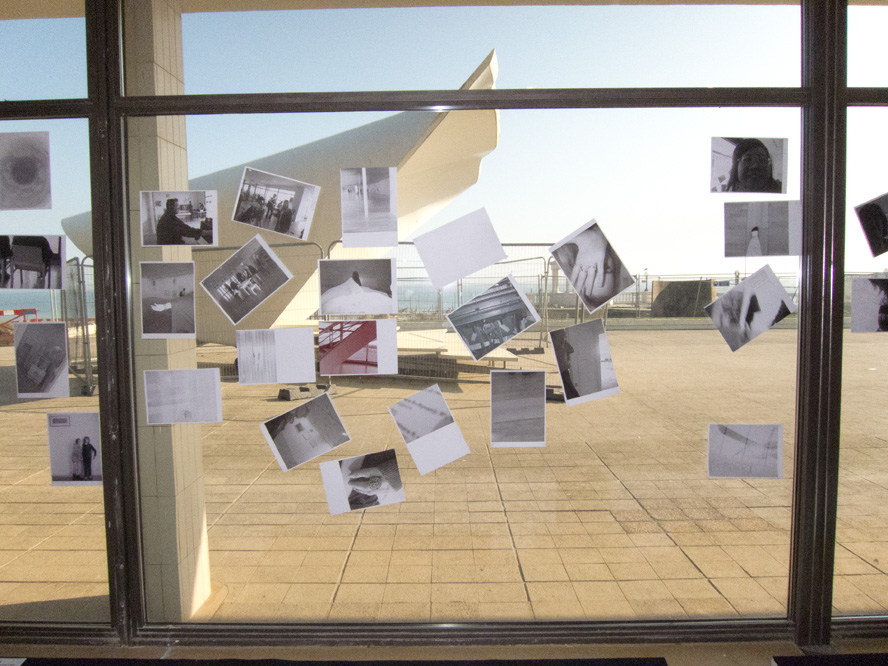
This was the first interaction in the gallery for the John Cage season and we were lucky enough to have beautiful weather, a packed gallery and a designated space for the interaction session. The area  - in which you could also watch videos on John Cage - proved to be invaluable and along with my two wonderful volunteers, Josef Konczak and Will Richards we created a real hub of creativity, inventiveness and discussion.  Those that interacted were asked to  take photographs of parts of their own bodies or something close to them, randomly pressing the shutter at a time when an utterance was heard within the gallery space, that stood out above all others.  The photographs were meant to be immediate and taken without traditional aesthetic framing. The images were then converted into black and white files and printed. The utterance or sound was then added to the image with pencil.

The idea was to produce images inspired by Cage’s idea of chance and forced artistic limitations.  Specifically inspired by Seven Day Diary (Not Knowing), 1978, the artworks produced reflected a particular time and place, the juxtaposition between text and imagery engaging with the relationship between the self and chance encounters. For the duration of the Saturday interaction the prints were shown on the windows of the workroom. 
The exercise instigated much dialogue about how easy it was to follow a specific brief and relinquish the desire for creative autonomy.  Many found this challenging and liberating when they achieved a work of art created entirely by chance.  Those with a more prescriptive notion of producing artworks had two or three attempts before producing something that appeared to be just chance encounters.  Some discussions developed into philosophical ideas of  'autonomy' in art and whether it was still 'you' producing the artwork as they seemed so determined by chance. Each print produced was unique and represented personal artistic integrity, despite being produced from an outside brief.  Interesting dialogues were instigated about the 'value' of the art object in relation to the amount of 'work' put in to the final piece.  I shall be doing the exercise again on the 7th May and will be very much looking forward to the afternoon.