Wednesday, 4 May 2011

Lift the Lid: Games with colour and sound


This month's Lift the Lid took its inspiration from the John Cage exhibition in the gallery. Cage was interested in the use of playful, game-like strategies to drive the process of making visual art and music. So we decided to play in a similar way.
Everything was based around the use of 12-sided dice, which took on the role of making creative decisions for all the activities. The dice decided which colours to use, which squares to colour, which notes to play.


We coloured grids of various degrees of complexity - including one where you had to make up your own set of rules to complete it.


We composed music on glockenspiels, using 12 notes to correspond to the 12 numbers on the dice.

Each composition was added to a musical score,

which grew,

and grew throughout the afternoon.


The anticipation and randomness of rolling dice seems to infect everyone with excitment. There is also the simple pleasure of following a enjoyable course of action, rather than worrying about having to make decisions. Nevertheless, you can always add further dimensions by contributing your own rules to the process.


Thank you to everyone who joined in and many thanks to my lovely volunteers, Pat and Ben, who kept the dice rolling.

Apparently our glockenspiels could be heard ringing out all over the Pavilion, competing with Charlie Hooker's grand piano: an impromptu performance true to the spirit of John Cage.

Tuesday, 3 May 2011

Gallery interaction with Sheridan Quigley: Playing games to make pictures


It has often struck me that what is hard to grasp in an exhibition (any exhibition) is the sequence of time-consuming, highly involved processes an artist can go through to make a piece of work. The finished image/artefact appears in a gallery: self-contained, "perfected" and presented. The toil and the anguish are invisible. For John Cage, the process of creating the work was more important the finished image. He was interested in the adventure of defining a set of rules for himself and then setting off to explore where they took him. The objective was not to create a brilliant piece of art, but to devise an interesting game.

For my interaction with this quietly inspiring exhibition, I wanted to take the participants right inside the actual process Cage utilised to create images such as the Ryoanji (Zen rock garden) series.
Cage used incredibly meticulous chance operations, based around the ancient Chinese divination tool, the I Ching, repeated over and over to create a single image.

Sheet showing the 64 hexagrams of the I Ching

Throwing coins to create hexagrams

The I Ching is made up of 64 hexagrams (sets of different arrangements of six continuous and broken lines), each with its own meaning. The enquirer asks a question of the I Ching, while throwing three coins, six times. Chance provides an answer in the form of a hexagram, which is interpreted using the text of the ancient I Ching book. We were using the I Ching to find numbers rather than asking portentious questions. However, we did focus our minds on how we might want our images to turn out.

I introduced my participants to the coin throwing process, to make hexagrams which they checked against a list. They were also given a sheet of paper printed with a grid of 64 numbered squares, on which they used their hexagram numbers to plot a drawing.
  • Throw a set of three coins: record how they fall as a combination of heads and tails.
  • Repeat this six times to create a hexagram (there are 64 possible combinations of lines).
  • Identify the hexagram and its corresponding number.
  • Locate the number on the drawing grid.
  • Place a stone over numbered square on the grid and draw round it.
  • Repeat the process as many times as you wish. Cage might do this perhaps 100 times.
Drawing around stones


Faced with the highly structured nature of this interaction, the standard response from my participants was "...oh, I'll just have a quick go." But once they'd begun, everyone got drawn into the calm, repetitive process. Cage's images in the gallery are recordings of a peaceful state of mind, free from the anxiety that creative decision-making can engender. I became aware of how this mindset overtook the participants as they settled into making their pictures. Many stayed for half an hour, or more. The playfulness of the process added to lightness with which the work was undertaken. We all laughed at lot.


Thank you to everyone who participated. I gained a greater insight into the exploratory potential of this type of process as a result of working with you. And to all of you who took extra sheets home to continue with your ideas, I hope you have had fun with it.

Thursday, 28 April 2011

Gallery Interaction Saturday 23rd April with Irene Mensah


Today was a very warm and sunny Saturday during the Easter Weekend and the public's minds were possibly not going to be inspired by the thought of engaging with the taxing activity of a creative writing exercise. This was born out by my first endeavours to invite members of the viewing audience to help me with this experiment. So I took a firm approach and the journey commenced.

The idea today was to draw upon the text in the titles John Cage had given to his different works and then by an instinctive and random decision to choose 3 to 5 words from 2 titles.
These words would then become the basis for a exploring a playful journey with creative writing by using them in any sequence or manner which seemed to suggest itself to the individual. With the addition of pencils being on long canes and the writing to take place from standing, the slightly disconcerting nature of this action gave a extra focus to the action and hopefully would promote a greater freedom in writing.

My first two participants, Ruth and Julia immediately took a different approach by preferring to create visual images rather than text, but once coerced into the activity they had fun and also were drawn into their own dialogue with interpreting the titles chosen which was part of the objective. I was quite moved by the writing which was created by Nick and Stephen, as they each had a piece of prose which had a wonderfully profound depth to it. This is there work which I would like to share with their agreement to a wider public:

Nick's selected words: River Rocks And Smoke

With a violent lurch
The boat was swept downstream
The thick heavy ash filling my mouth
And my cheeks raw with the heat
And rising adrenalin

Stephen's selected words: Wanting Variations Disappearances

Wanting variations in disappearance
We want to go down to the water
Every day we are discussing this
Some days we are describing it so clear that it has become in
Our imaginations. Once there
was an argument about when
we should go but we realised
that is beside the point. We
are going going going going going

An extremely mature young boy called Scott Griffiths, engaged so beautifully with the exhibition, that his comments as well as his consequent contribution were equally insightful. I think John Cage would have been pleased by Scott's comment in relation to his favourite print which he perceived to resemble a drawing by someone who has never drawn before. By this he elaborated that he meant that it wasn't like anything else he'd seen, but seemed fresh and new. I admired his clarity at the age of 8. He then drew in inspiration by this piece which you can see below.


Jeff Newnham was a humourous and playful participant who was fascinated by the fact; "that you never know how you will get from double six to double five", relating to the transition from one point in the game of dominoes to another. and his comment; " It is the gaps in between places which other people will fill in" both related to this but also seemed like a metaphor for understanding the random and uncontrollable aspects of our collective lives.


I would like to thank my last participant who concluded the afternoon's explorations, and was a charming older gentleman called Raj who was drawn to the word River in no 72 New River Watercolours. His was a lovely loose response which combined both text and imagery.

I really appreciated the efforts of all who participated on such a hot afternoon and the variety of creative pieces which were generated by this experiment. Many of those individuals found that from this freedom to take their own path starting with something as simple as a few words, that they found a different level on which to connect with John Cage's work.

They were at times surprised to find themselves stimulated by their own ability to be creative and to also enjoy the process. Such is the power of personal random journeys, and the special way in which the the thinking behind the work of John Cage can open doors to unforeseen ways of stimulating artistic expression in an ever continuing response back and forth between self and the outside world.

Saturday, 23 April 2011

John Cage: Every Day is a Good Day. Gallery Interaction 16th April


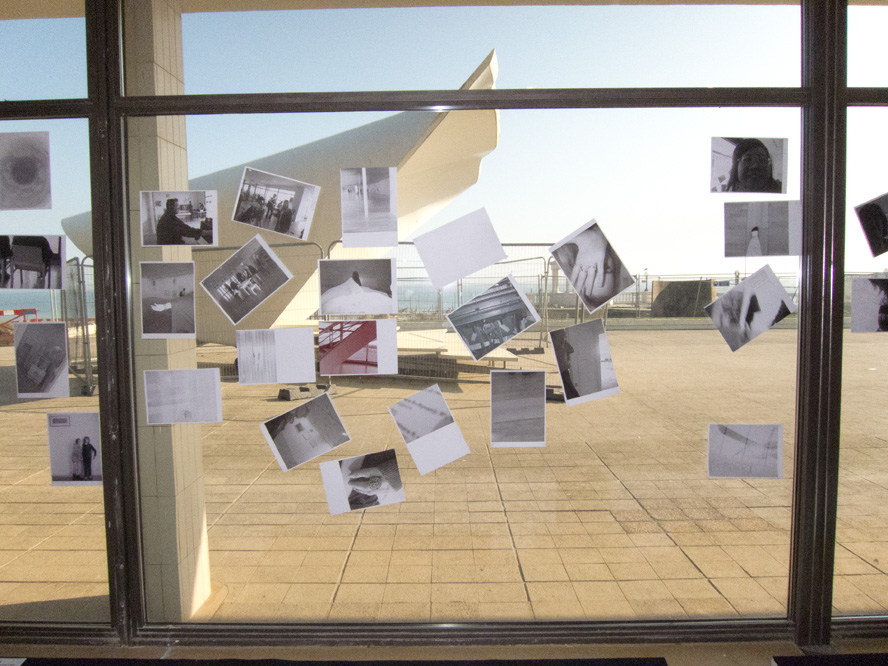
This was the first interaction in the gallery for the John Cage season and we were lucky enough to have beautiful weather, a packed gallery and a designated space for the interaction session. The area  - in which you could also watch videos on John Cage - proved to be invaluable and along with my two wonderful volunteers, Josef Konczak and Will Richards we created a real hub of creativity, inventiveness and discussion.  Those that interacted were asked to  take photographs of parts of their own bodies or something close to them, randomly pressing the shutter at a time when an utterance was heard within the gallery space, that stood out above all others.  The photographs were meant to be immediate and taken without traditional aesthetic framing. The images were then converted into black and white files and printed. The utterance or sound was then added to the image with pencil.

The idea was to produce images inspired by Cage’s idea of chance and forced artistic limitations.  Specifically inspired by Seven Day Diary (Not Knowing), 1978, the artworks produced reflected a particular time and place, the juxtaposition between text and imagery engaging with the relationship between the self and chance encounters. For the duration of the Saturday interaction the prints were shown on the windows of the workroom. 
The exercise instigated much dialogue about how easy it was to follow a specific brief and relinquish the desire for creative autonomy.  Many found this challenging and liberating when they achieved a work of art created entirely by chance.  Those with a more prescriptive notion of producing artworks had two or three attempts before producing something that appeared to be just chance encounters.  Some discussions developed into philosophical ideas of  'autonomy' in art and whether it was still 'you' producing the artwork as they seemed so determined by chance. Each print produced was unique and represented personal artistic integrity, despite being produced from an outside brief.  Interesting dialogues were instigated about the 'value' of the art object in relation to the amount of 'work' put in to the final piece.  I shall be doing the exercise again on the 7th May and will be very much looking forward to the afternoon.

Wednesday, 6 April 2011

Lift the Lid 3 Moving Insect Portraits Sunday April 3rd

Moving Bug Portaits......


For this third session the theme was to identify a favourite insect, and then create a portrait of yourself as this insect which would be able to move: a moving bug portrait!

Here is Angelica holding her selection of bees and butterflies


Whilst her brother Vinnie shows off his caterpillar...


The above caterpillar is clearly in full motion and a lively collaboration between mother and daughter.

The afternoon was less busy than usual as it was Mother's day and in between exhibitions, but everyone who came to the session quickly identified with their favourite insect, such as the multi-dimensional butterfly by Caoimhe seen below, and went straight into action.


Ladybirds and bees were very popular and some very focused concentration on making them move was inspiring to witness in participants of all ages. Below are companion dragonflies created by a sister and brother:


This last image was of a wonderful insect created by a gentleman called David who deftly used pipe-cleaners to make his 3-D artwork and sums up the imaginative approach towards the final selection of Moving Portraits...


Lift the Lid 2: Shoe Portraits March 5th


It could be said that a shoe give all kinds of insights into the unique personality of any individual, the tiny detail of a type of stitching, colour, traditional style, eccentric etc all indicate sometimes unconscious facets of the wearer. By creating a shoe as a portrait, what kind of information would be passed on to a viewer?


With a lovely group of intrepid workshop participants much activity was spent creating shoes in widely varying forms from 2 dimensional as below:


To these sculptural creations... So what does a shoe portray about its owner?


The workshop drew upon the work from the preceding Lift the Lid, where portraits were created in the form of a story, drawing and or collage as reinterpretations of a selection of the Moving Portraits exhibition. From 5 instructions family groups could identify key aspects of a portrait and then eventually create their own which may or may not correspond to the way that others would perceive the same portrait.
The choice was then offered to the participants of this session to either create a shoe which they thought that the person in one of the portraits might wear, or one for themselves, taking into consideration the exhibition and own likes and dislikes.


So a fabulously colourful range of footwear emerged, and one pair of friends taking up the invitation to create a dance with their shoes, which turned one corner of the space into a dance area, see below.


The result was to create a new version of moving portraits, as the shoe portraits became alive and were danced and moved around the space before being taken home. Thank you to all those who participated so imaginatively.


Tuesday, 22 March 2011

Gallery Interaction 19th March

Thank you to all who wanted to take part in the interaction with Guy Sherwin's short film, "Portrait of Parents" 1975.  As per my previous post, this is a 3 and a half minute film looking at the idea of portraiture through the moving image.  The participants were asked to engage with the film, which features Guy Sherwin -seen in as a reflection in the mirror- filming his parents.   We discussed the relationships between the son and his parents and their 'performance' for the camera.  We discovered that the viewers relationship with the film is substantially changed when also filmed and this added an additional dimension, becoming part of or extending the performance and the narrative.

There were many students visiting this week as next weekend will be the last chance to see the exhibition!  If you haven't already seen this brilliant show, "Moving Portraits", I highly recommend that you do.  Well worth the effort, especially to catch the film "Bernadette" by Duncan Campbell....a must see!