Saturday, 22 January 2011

Moving Portraits. Gallery Interaction

The De La Warr Pavilion's new exhibition of video art began today. Good turnout, opening speeches by director of DLWP Alan Haydon (on right in picture) and the director of The National Portrait Gallery Sandy Nairne, who declared the show "of national importance". And he's right, there's not been anything before that can be directly compared to it.


My task, as part of this years interpretation team, was to enhance visitors' experience of the exhibition. I decided to do this by asking willing visitors to design a five second moving portrait as a way of thinking about possible decisions behind the work on show.

They did this by filling in a short form (point of view, what happens, stickman sketch of composition etc). We then filmed it on one of the Pavilion's little digital compacts, usually in one take, later simply presented in the order in which they were made. Thanks to all who are now famous for 5 more seconds and Penny Hobson who assisted and recruited.


Twenty Two Five Second Moving Portraits. 22 January 2011.


(best viewed nice and small, not full screen).


Wednesday, 12 January 2011

Beckham arrives at DLWP

One of England's national treasures, world-class footballing legend David Beckham has entered the DLWP building!

OK, so it may not be the footballing legend in the flesh but Sam Taylor-Wood's David (2004), an hour-long silent film of David Beckham sleeping, gives us a glimpse of the star away from the cameras, in a precious moment of 'down-time'. The film was shot while he was taking a siesta after an training session with Real Madrid and shows an initmacy with its subject that the viewer does not usually see - even with the deluge of paparazzi and celebrity images taken over the years.

You can enjoy this fascinating portrait alongside Andy Warhol's series of screen tests featuring friends, colleagues and acquaintances such as Marcel Duchamp, Lou Reed and Edie Sedgwick and Peter Gidal's 1969 work Heads; filmic portraits of British personalities including Marianne Faithfull and David Hockney. You'll see experimental works, works with well-known sitters as well as more personal portraits of friends and family. Click here to read more about Moving Portraits: sixty years of portraits on moving image (22 Jan - 27 Mar).
To accompany the Moving Portraits exhibition, a programme of biographical and character-led films will be shown in Gallery 2 during the day and on Thursday and Saturday evenings. There are memorable classics by international film-makers, Hollywood productions and a selection of films by artists. Click here for a full list of what's on.

Tickets: £3 afternoons / £6 for a ticket + glass of wine or half pint of Peroni at evening screenings. Box Office: 01424 229 111 http://www.dlwp.com/

Image One: Richard Billingham, Fishtank, 1998; video installation (video still), produced and commissioned by Artangel, 46 mins 40 secs. © the artist, courtesy Anthony Reynolds Gallery, London.
Image Two: Sarah Purcill (UK) You be Mother, 1990, 16mm col, sound 7min.

Wednesday, 5 January 2011

DLWP sets sail with Catherine Yass

It was a cold but near perfect day to sail out to sea on a boat. Catherine (Yass), Alan and I set off at Eastbourne Sovereign Harbour on a charter boat. The lighthouse is 5 miles away from the harbour which takes around half an hour each way.

I have been very curious - as have many others I'm sure - to see this structure which stands in the middle of the sea, all alone. It's only just visible from the Pavilion on a clear day and difficult to judge the real size of it. Catherine and I took many photographs for research, looking at the way the strucutre has aged and its access possibilities. We will have to wait and see what Catherine's artistic outcome from this research trip will be, but it's certainly an exciting start to the project.
Jane Won (Curator, DLWP)


Sunday, 2 January 2011

Lift The Lid family session: MMXI


The final Lift The Lid accompanying Myth, Manners and Memory. The Pavilion was very busy with people from far and wide catching the show before it closes and getting over Midwinter cabin fever.

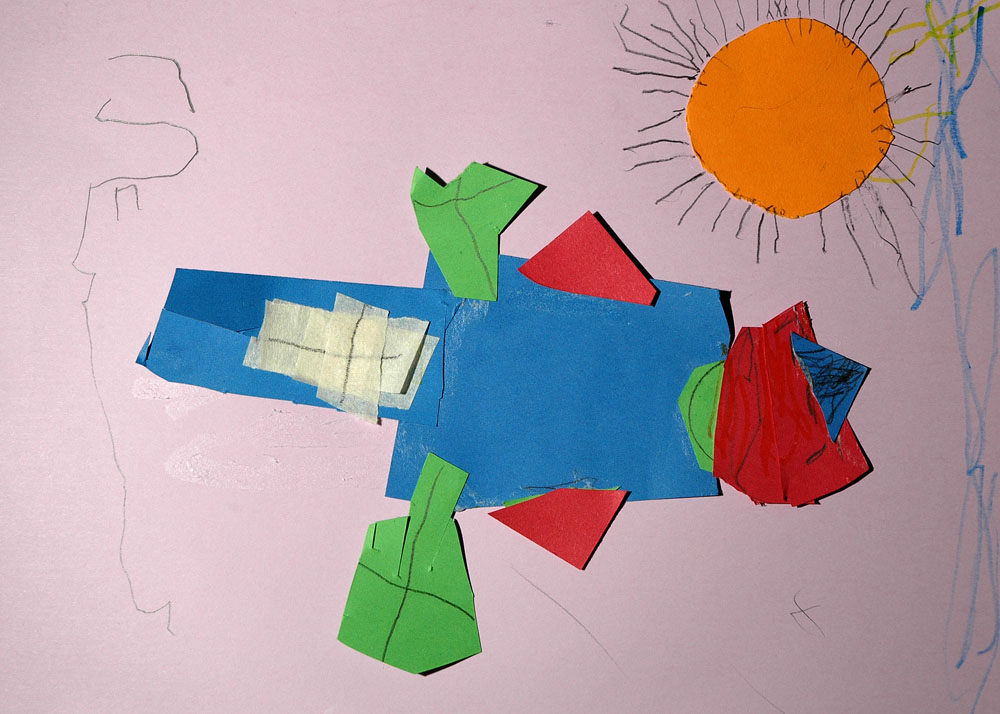
The session had a nominal theme of describing hopes, wishes, predictions or expectations for 2011. However it was also intended to be a bit of a free for all with an emphasis on colour and collage. It's a bit unfair to ask someone who's only been alive for 4 or 5 years what their opinion about a whole year might be, so let's just open that glue stick.

Many thanks to all who came for all your brilliant work and also to our excellent assistants, Nik Medhurst and Ben Wade.

Myth, Manners and Memory: Photographers of the American South has been a very well liked exhibition. Both as a photography show, for which there seems to be a definite current appetite, and also as a vehicle for issues and approaches that seem relevant or interesting now. For me, that has meant a lot of very interesting conversations in the building and the pleasure of working with an exhibition that rewarded multiple viewings.


Lift The Lid is the De La Warr Pavilion's free drop in session for families on the first Sunday of every month from 2-5pm.


Sunday, 5 December 2010

Lift The Lid: Do You Abstract?


"Find shapes, colours and textures that you like in the exhibition and the building. Use pencils, collage, photography and whatever else you can think of to make an ABSTRACT picture".


The snow and ice were gone and it was a great day to get out of the house, but Bexhill was very, very quiet and so was the Pavilion. The car park outside the De La Warr was free for this pre-Christmas weekend but strangely emptier than usual.

Maybe sensing that they almost had the place to themselves, our compact Lift The Lid group developed an anarchic edge.

Children, of course, take naturally to abstraction (they often just don't know that's a name for it) so I was expecting a smooth ride. Maybe it was some grown ups drawing cartoon figures or quietly doing a little origami, or maybe it was Max's robot that began the shift from making abstract art to throwing paper aeroplanes around the room.

There must be very few people on Earth who have never made and launched a paper aeroplane, it's a universal experience. To do this with children is a lovely reconnection and had the great side effect of making everyone in the room focus on the same thing as watching them fly and commenting on flight style/design/launch technique is irresistible.

Towards the end of the afternoon a gentleman came in who'd been in the RAF in the 1950's. We got into conversation about early jet bombers and abstraction was completely out of the window.


Thanks to everyone for an excellent afternoon. Volunteers were Corin Smith (her last session as part of a Duke of Edinburgh Award) & Ben Wade (who, in a quiet act of resistance to the brief, made an elegantly engineered paper Christmas tree).

Lift The Lid is the De La Warr Pavilion's free drop in session for families on the first Sunday of every month from 2-5pm.


A Journey through Memory and Music 4th December by Irene Mensah


The disruptive weather was not conducive to a busy attendance of the gallery, but today's public although much reduced, were extremely open to responding to my request to conduct a small experiment with their way of seeing. I decided to remain with my theme of seeing through listening, but open to taking unforeseen routes where possible.

My conversation with Matthew John was one such experience. We discussed the value of finding ways of connecting with the person behind the lens. Matthew put his thoughts very succinctly; "People stir up memories, which stir up music". As a collector and artist himself he was interested in knowing more about the mind which created the image, and what their story might be.

Through the personal connections with details within an image, such as William Christenberry's rabbit pen, we agreed that our own memories then evoked a new journey,
which will cause the original image to remain with us long afterwards as a legacy. Matthew's journey went from his childhood collection of postcards from holidays to appreciating his parent's wishes to give him the opportunity to broaden his experience and understanding of other countries, to his love of engaging with simplicity and integrity in art.

One young mother responded immediately to my request, as the music from the film "Deliverance" had already come to mind for her as she went round the exhibition.

A musician couple were delighted to think of the addition of sound, with music already an integral part of their lives. Their responses to the exhibition became more exploratory and questioning of the lives and experiences of the subjects and locations.
They were very interested in the juxtaposition of Walker Evans' work with that of Carrie Mae Weems, both of which were their personal favourites. Our discussion prompted them to observe that the work by Weems represented a true liberation from the time when the impossible injustice of slavery was a reality as documented by Evans.

I will share the different moments as they were presented to me, like stepping stones connecting the personal to communal interpretations of the photography.
A takeaway curry for Christmas day
Potential for a reminiscence exhibition from a carefully curated postcard collection
Keats poetry (to calm the anxiety provoking nature of Susan Lipper's photography)
Pulp fiction and John Travolta's dancing (to lighten the effects of Lipper's distressing portraits)
Feeling too young and British (struggling to connect with the unfamiliar nature of the American South)
Smelling burning smoke (cigarette smoke from Susan Lipper's portraits)
Madonna in Desperately Seeking Susan
Bright Eyes by Art Garfunkel
Like black and white photography
Don't like black and white photography
Sensory interaction.


Wednesday, 1 December 2010

The South is...?


A snow-bound pavilion, with beautiful ghostly views across the snow-topped rotundas to a thick, hanging seascape. Not a day to attract crowds of gallery-goers, except for cold weather enthusiasts (myself included). However, we welcomed over 50 visitors into the exhibition during the afternoon.

My question to the exhibition was: “What is the South?” – how does this pejorative concept emerge from the work on show? Does a “South” exist in all countries? Is it a myth in itself? I designed my interaction around William Christenberry’s “Red Building”, which I turned into a comment card, looking for definitions. Here are some of the diverse thoughts:

The South is…”a colourful, poor, cruel, historical, segregated, vast, messy, frontier.”

The South is…”a reminder that American culture isn’t as comfortably, tediously uniform as some might have you believe.”

The South is…”being able to walk freely across the beaches and the countryside, through the towns and cities – whoever you are…”

The South is…”in search of amusement…”

The South is…”stark, colourful, barren, lush”.

The South is…”not the North. Bruised, beat-up and abandoned – “this land is condemned at the way from New Orleans to Jerusalem” (Dylan).”

Three of the most interesting conversations I had during the afternoon were with visitors who are either American or who have lived in the United States for a while. They all separately expressed the view that the sense of hopelessness and melancholia they read from the photographs are only one facet of the “South”, and that the exhibition (although they all liked it very much) reinforces the myths we tend to believe about the place. While other powerful elements, such as the dynamism of the cities and the genteel elegance of the manner of the people (in all walks of life) are invisible.

As with the other days when I have been interacting in the gallery, there were a number of visitors who were enthralled to see original prints by their photographic heroes. In particular, William Eggleston’s highly saturated surfaces are so rich it looks as if the colour could bleed on to the floor. This intensity is a vital component of his vision and cannot be replicated in books about the artist’s work.

Thank you to everyone who participated. It is always a pleasure to turn a gallery space into an environment where people can share impassioned views, rather than feeling they have to whisper.