I have been very curious - as have many others I'm sure - to see this structure which stands in the middle of the sea, all alone. It's only just visible from the Pavilion on a clear day and difficult to judge the real size of it. Catherine and I took many photographs for research, looking at the way the strucutre has aged and its access possibilities. We will have to wait and see what Catherine's artistic outcome from this research trip will be, but it's certainly an exciting start to the project.
Wednesday, 5 January 2011
DLWP sets sail with Catherine Yass
I have been very curious - as have many others I'm sure - to see this structure which stands in the middle of the sea, all alone. It's only just visible from the Pavilion on a clear day and difficult to judge the real size of it. Catherine and I took many photographs for research, looking at the way the strucutre has aged and its access possibilities. We will have to wait and see what Catherine's artistic outcome from this research trip will be, but it's certainly an exciting start to the project.
Sunday, 2 January 2011
Lift The Lid family session: MMXI

The final Lift The Lid accompanying Myth, Manners and Memory. The Pavilion was very busy with people from far and wide catching the show before it closes and getting over Midwinter cabin fever.
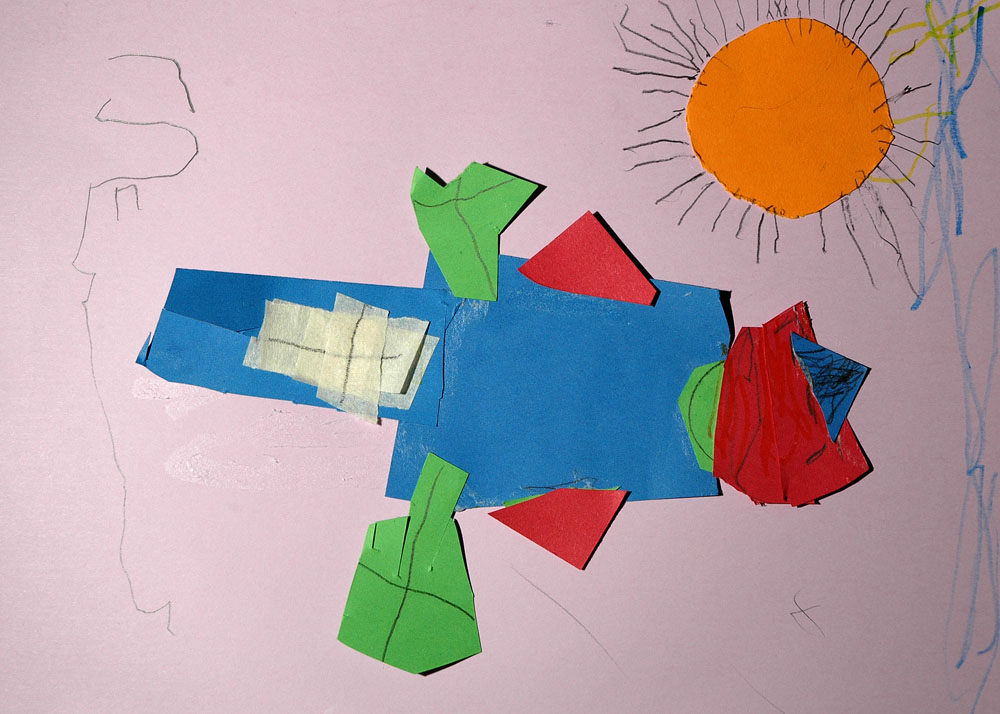
The session had a nominal theme of describing hopes, wishes, predictions or expectations for 2011. However it was also intended to be a bit of a free for all with an emphasis on colour and collage. It's a bit unfair to ask someone who's only been alive for 4 or 5 years what their opinion about a whole year might be, so let's just open that glue stick.
Many thanks to all who came for all your brilliant work and also to our excellent assistants, Nik Medhurst and Ben Wade.
Myth, Manners and Memory: Photographers of the American South has been a very well liked exhibition. Both as a photography show, for which there seems to be a definite current appetite, and also as a vehicle for issues and approaches that seem relevant or interesting now. For me, that has meant a lot of very interesting conversations in the building and the pleasure of working with an exhibition that rewarded multiple viewings.


Lift The Lid is the De La Warr Pavilion's free drop in session for families on the first Sunday of every month from 2-5pm.
Sunday, 5 December 2010
Lift The Lid: Do You Abstract?

"Find shapes, colours and textures that you like in the exhibition and the building. Use pencils, collage, photography and whatever else you can think of to make an ABSTRACT picture".
The snow and ice were gone and it was a great day to get out of the house, but Bexhill was very, very quiet and so was the Pavilion. The car park outside the De La Warr was free for this pre-Christmas weekend but strangely emptier than usual.
Maybe sensing that they almost had the place to themselves, our compact Lift The Lid group developed an anarchic edge.
Children, of course, take naturally to abstraction (they often just don't know that's a name for it) so I was expecting a smooth ride. Maybe it was some grown ups drawing cartoon figures or quietly doing a little origami, or maybe it was Max's robot that began the shift from making abstract art to throwing paper aeroplanes around the room.
There must be very few people on Earth who have never made and launched a paper aeroplane, it's a universal experience. To do this with children is a lovely reconnection and had the great side effect of making everyone in the room focus on the same thing as watching them fly and commenting on flight style/design/launch technique is irresistible.
Towards the end of the afternoon a gentleman came in who'd been in the RAF in the 1950's. We got into conversation about early jet bombers and abstraction was completely out of the window.
Thanks to everyone for an excellent afternoon. Volunteers were Corin Smith (her last session as part of a Duke of Edinburgh Award) & Ben Wade (who, in a quiet act of resistance to the brief, made an elegantly engineered paper Christmas tree).
Lift The Lid is the De La Warr Pavilion's free drop in session for families on the first Sunday of every month from 2-5pm.


A Journey through Memory and Music 4th December by Irene Mensah
The disruptive weather was not conducive to a busy attendance of the gallery, but today's public although much reduced, were extremely open to responding to my request to conduct a small experiment with their way of seeing. I decided to remain with my theme of seeing through listening, but open to taking unforeseen routes where possible.
Wednesday, 1 December 2010
The South is...?
A snow-bound pavilion, with beautiful ghostly views across the snow-topped rotundas to a thick, hanging seascape. Not a day to attract crowds of gallery-goers, except for cold weather enthusiasts (myself included). However, we welcomed over 50 visitors into the exhibition during the afternoon.
My question to the exhibition was: “What is the South?” – how does this pejorative concept emerge from the work on show? Does a “South” exist in all countries? Is it a myth in itself? I designed my interaction around William Christenberry’s “Red Building”, which I turned into a comment card, looking for definitions. Here are some of the diverse thoughts:
The South is…”a colourful, poor, cruel, historical, segregated, vast, messy, frontier.”
The South is…”a reminder that American culture isn’t as comfortably, tediously uniform as some might have you believe.”
The South is…”being able to walk freely across the beaches and the countryside, through the towns and cities – whoever you are…”
The South is…”in search of amusement…”
The South is…”stark, colourful, barren, lush”.
The South is…”not the North. Bruised, beat-up and abandoned – “this land is condemned at the way from New Orleans to Jerusalem” (Dylan).”
Three of the most interesting conversations I had during the afternoon were with visitors who are either American or who have lived in the United States for a while. They all separately expressed the view that the sense of hopelessness and melancholia they read from the photographs are only one facet of the “South”, and that the exhibition (although they all liked it very much) reinforces the myths we tend to believe about the place. While other powerful elements, such as the dynamism of the cities and the genteel elegance of the manner of the people (in all walks of life) are invisible.
As with the other days when I have been interacting in the gallery, there were a number of visitors who were enthralled to see original prints by their photographic heroes. In particular, William Eggleston’s highly saturated surfaces are so rich it looks as if the colour could bleed on to the floor. This intensity is a vital component of his vision and cannot be replicated in books about the artist’s work.
Thank you to everyone who participated. It is always a pleasure to turn a gallery space into an environment where people can share impassioned views, rather than feeling they have to whisper.
Sunday, 21 November 2010
Gallery Interaction, 20th November: Adding Information
I wanted to see what visitors could add to the exhibition by way of facts and observations. I added information myself by laying out printouts as a catalyst for conversation. These were Interviews with the photographers, reviews of previous shows and articles about print processes, Federal Writers' Project and the Farm Security Administration.
There was a lot of interest in print processes. All the images in the exhibition are made on film but then printed using either analogue (C-Type, Dye Transfer) or digital processes affecting the image in subtle but relevant ways. I had an interesting chat about the Walker Evans prints with a visitor from London whose most treasured possession is a print by W. Eugene Smith.
Some of the observations and facts from visitors:
There are no trailer parks/homes in this exhibition
The cloud that looks like an angel - Alec Soth's Bonnie (with a photograph of an angel), Port Gibson, Mississippi, 2000 - is called a simulacra... but also a 'slyth' or a 'slyfth' I think - common on webpages, also thinking about 'chemtrails'.
The tree in the Alec Soth picture (Holt cemetery, New Orleans , Louisiana 2002) - they're also in Florida, we call them 'spooky trees'. The light bulbs in his pictures are all switched on (even outside Johnny Cash's boyhood home in daylight).
Eggleston's pictures have been used on albums by Big Star (Red Ceiling, Greenwood, Mississippi) and Primal Scream.
Federal Writers' Project slave narrative collection - more people are in slavery worldwide now than then (heard on radio 4 but not written down as washing up).
From a Walker Evans photograph - there was 7up in the thirties.
Susan Lipper - there's a pistol in the belt of the 'blowback man'. Hanging a deer - seen that in Robertsbridge.
William Christenberry (green barn photographed over 31 years) - no graffiti at all!
Everyone I spoke to over a 3 hour period was very positive about this exhibition. The disapproval that greeted Eggleston's work in the 1970's would seem to be unusual now. People do really enjoy thoughtful, often quiet, photographs of everyday life.